
CYBER ESSENTIALS
From Annual Certification to Continuous Security
Passing Cyber Essentials once a year is good. Staying secure throughout the year is better.

Cyber Essentials provides an important foundation for protecting organisations against common cyber threats. But certification is an annual process, while cybersecurity threats, vulnerabilities and technology environments change continuously.
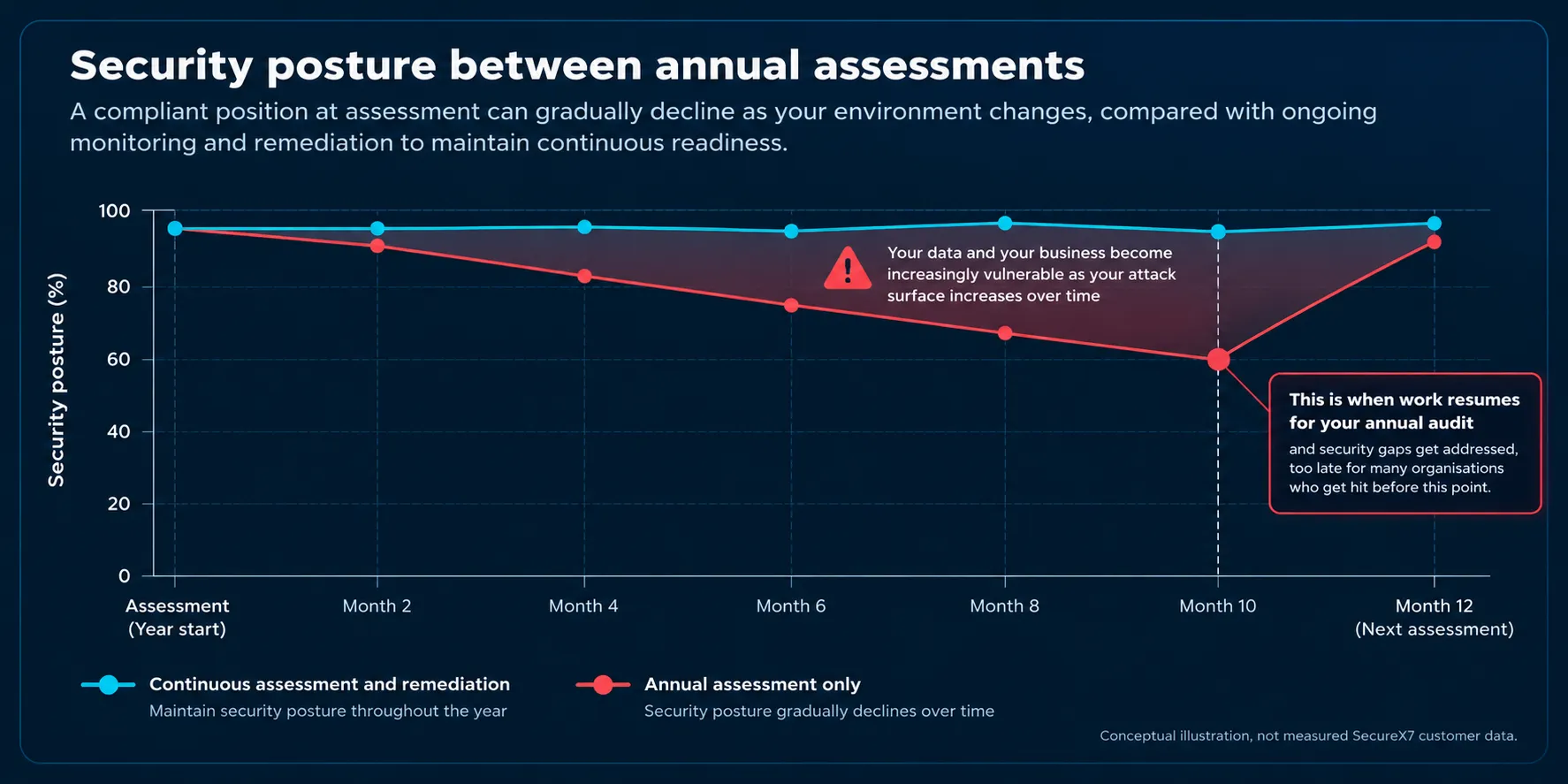
An organisation may successfully complete its Cyber Essentials assessment with appropriately configured devices, supported software and effective security controls. Yet within weeks, new vulnerabilities may emerge, software may become outdated and configuration changes may introduce weaknesses that were not present during certification.
The result is a growing gap between the security posture demonstrated during assessment and the actual protection maintained throughout the year.
Continuous Cyber Essentials readiness closes that gap by making security assessment, remediation and verification an ongoing process rather than an annual exercise.
SecureX7 helps organisations achieve this through automated asset discovery, security configuration assessment, vulnerability identification and AI-powered actionable remediation guidance.
Don't just ask whether you passed Cyber Essentials last year. Ask whether your security controls are effective today.
The Problem with Point-in-Time Readiness
Your certificate lasts twelve months. Your security posture can change overnight.
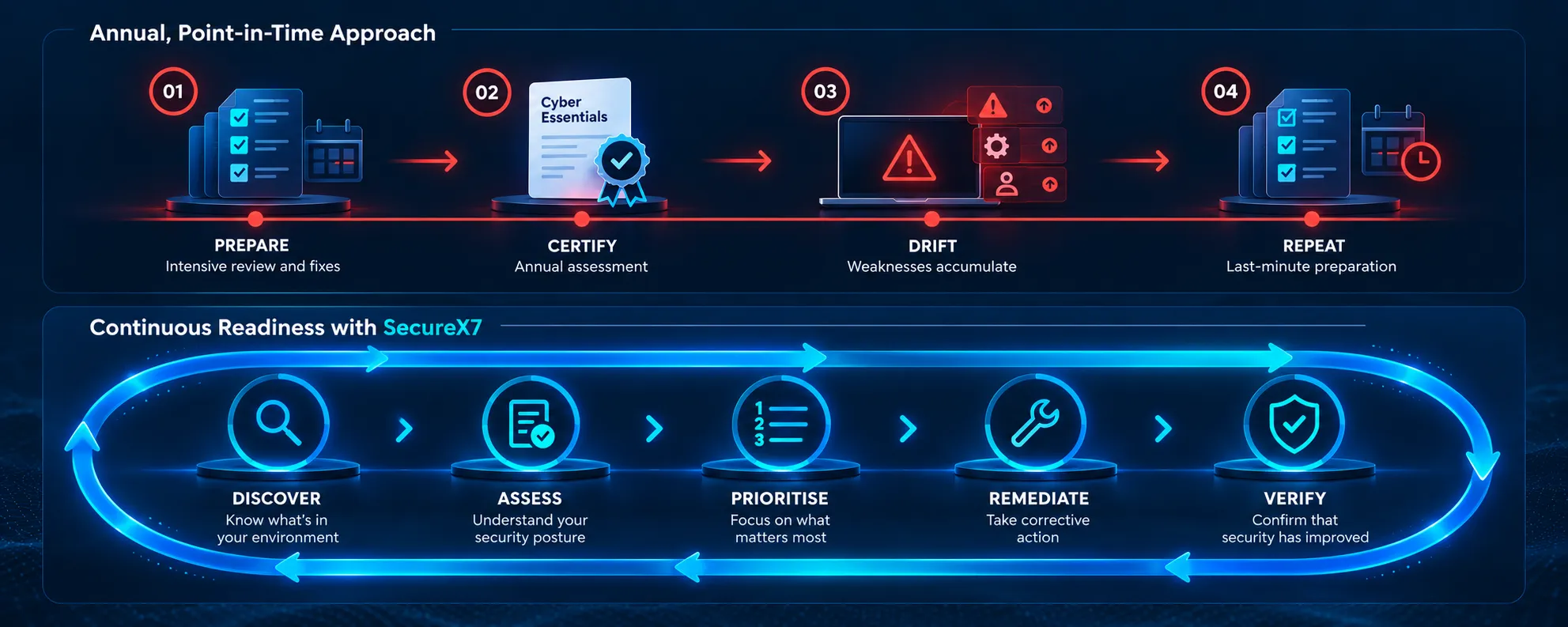
Traditional Cyber Essentials preparation often follows a familiar pattern. As the annual assessment approaches, organisations review their devices, identify outstanding vulnerabilities, correct security configurations and gather the information needed for certification.
Once the assessment is complete, attention frequently shifts elsewhere.
Unfortunately, the environment doesn't stop changing.
New laptops are introduced, employees join or leave, software is installed, security settings are modified and previously unknown vulnerabilities are discovered.
A firewall disabled during troubleshooting may remain switched off. An employee granted temporary administrator access may retain unnecessary privileges. A critical software vulnerability may remain unresolved because nobody is regularly checking for it.
These weaknesses can develop long before the next assessment is due.
Cyber Essentials certification demonstrates that an organisation has satisfied the scheme's assessment requirements. It does not guarantee that every security control will remain effective throughout the certification period.
The problem is not the annual certification process itself. It is relying on that process as the organisation's primary mechanism for discovering and correcting security weaknesses.
By the time preparations begin for the next assessment, problems may have accumulated for months.
Security weaknesses don't wait for your next audit. Neither should your security assessments.
A Continuous Readiness Model
Replace the annual compliance scramble with a continuous cycle of improvement.
Continuous readiness means maintaining an up-to-date understanding of your security posture and addressing weaknesses as they emerge.
Rather than allowing problems to accumulate until the next certification assessment, organisations establish a repeatable process for discovering changes, evaluating security controls and implementing corrective action.
A practical continuous readiness model follows five stages:
1. Discover — Know what's in your environment
Maintain visibility of in-scope devices, operating systems and installed applications. Identify newly introduced assets and software that may not yet have been assessed.
2. Assess — Understand your security posture
Regularly evaluate supported security configurations, software vulnerabilities and the technical controls relevant to Cyber Essentials.
Identify where actual device configurations differ from approved security baselines.
3. Prioritise — Focus on what matters most
Not every security finding presents the same level of risk.
Prioritise significant vulnerabilities, unsupported software and configuration weaknesses that could expose the organisation or undermine Cyber Essentials readiness.
Pay particular attention to qualifying security fixes that must be applied within 14 days of their release.
4. Remediate — Take corrective action
Apply security updates, restore appropriate configurations, remove unnecessary privileges and address other identified weaknesses.
Use clear remediation guidance to help administrators understand the corrective action required.
5. Verify — Confirm that security has improved
Reassess affected devices to establish whether corrective actions have been successful.
Continue repeating the process as devices, software, vulnerabilities and configurations change.
This approach supports more than certification preparation. It establishes a practical operating model for maintaining effective cybersecurity throughout the year.
The objective isn't continuous certification. It's continuous confidence in the security controls that underpin certification.
How SecureX7 Fits
Make continuous security assessment practical, automated and actionable.
For many organisations, the obstacle to continuous readiness is not a lack of commitment to cybersecurity. It is the time and effort required to assess devices, interpret technical findings and identify what needs fixing.
Manually reviewing firewall settings, administrator privileges, software versions and security configurations across an entire environment is difficult to sustain.
SecureX7 helps reduce that burden by bringing together the capabilities needed to understand and improve security posture.
Automated Asset Discovery
Identify devices and installed software, helping maintain visibility of the environment as assets are introduced, changed or removed.
Security Configuration Assessment
Evaluate supported device settings against established security requirements and identify configuration weaknesses that could undermine Cyber Essentials compliance.
Vulnerability Identification
Identify known software vulnerabilities, outdated applications and missing security fixes that require attention.
Prioritised Remediation Workplans
Organise identified weaknesses into actionable priorities, helping administrators focus on the issues that matter most rather than working through disconnected technical findings.
Embedded AI Security Expertise
Ask SecureX7 practical questions in plain English, such as:
"Would we pass Cyber Essentials today?"
"Where are our biggest security weaknesses?"
"Which devices have configuration problems?"
"What should we fix first?"
"What has changed since our last assessment?"
SecureX7 uses available assessment information to provide contextual answers and actionable remediation guidance.
Ongoing Reassessment
Repeat technical assessments to identify newly introduced weaknesses, monitor configuration changes and verify that remediation activities have been effective.
SecureX7 supports Cyber Essentials readiness by providing technical visibility, assessment and remediation guidance. It complements the organisational processes, evidence requirements and independent certification activities that remain necessary.
From annual preparation to continuous improvement. From disconnected findings to prioritised action. From uncertainty to a clearer understanding of your security posture.
Make Every Day a Step Towards Cyber Essentials Readiness
Your next Cyber Essentials assessment shouldn't be the first time you discover what needs fixing.
SecureX7 helps you understand your environment, identify security weaknesses and maintain the controls that matter throughout the year.
Know your estate. Assess your posture. Prioritise risk. Remediate confidently.